
Our current magazine
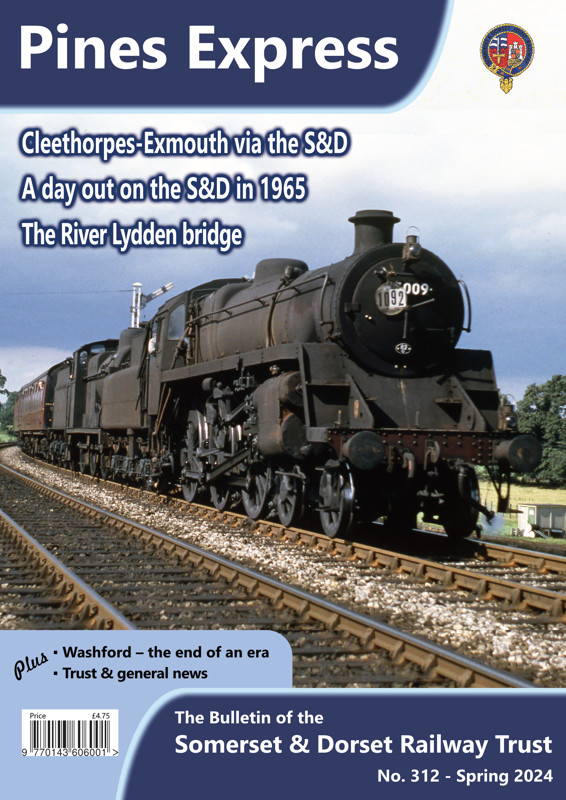
Our current magazine is the spring issue – read about it on the membership page, or click on the image.
Join us now!
We’re offering new applicants membership until the end of 2024 from £17.
In that time, you’ll receive four magazines full of great reading and photos. That’s excellent value – join now!
New mug featuring 53808 simmering at Alresford

We’ve just introduced this new high quality mug featuring a photo of the Trust’s S&D 7F quietly simmering at the platform at Alresford. Order here.
Welcome
Originally established in 1966, the Trust keeps alive the memory of this most distinctive of cross-country railways with its wide variety of artefacts including locomotives, carriages and museum exhibits backed by restoration work, events and our quarterly magazine.
Please note that the Somerset & Dorset Railway HERITAGE Trust is an unconnected organisation, albeit one that we work closely with. Their website can be found here.
Membership renewals here
AGM info. for members
Visit the Members’ Area for AGM documents.
The S&DRT blog
An in-depth look at the work of the Trust. See the latest posting ‘Re-examining Wells Branch Brake Van No.9 – the last surviving S&D goods vehicle‘.
Newsletter
Subscribe to our occasional email newsletter here.
Latest Press Releases
16 March 2023.
Announcement of loan agreement between S&DRT and NDR.
See all press releases.
Latest News
Somerset & Dorset Railway Trust on Facebook.
- Online Sales: Click on “Sales” at the top of this page or this link.
- Agreement on Washford between WSRHT & S&DRT
- Complete new range of model wagons available from Trust sales
- Last two engines depart from the S&DRT site at Washford
- Nigel Smart
- ‘Kilmersdon’ revisits the former Somerset coalfield with a stay at Midsomer Norton
- Agreement between the S&DRT and the West Somerset Railway Heritage Trust
- Leaving card for 53808 on last day of normal service
- Donations of S&D-related artefacts are welcomed, subject to our collections policy.
The Trust’s S&D 7F No. 53808
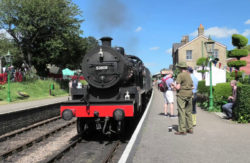
A brief history of the S&D 7Fs.
How the S&D 7Fs came into being.
The S&D Railway and the Trust
The Somerset & Dorset Railway ran from Bath across the Mendips and through Dorset to Bournemouth, with branch lines across the Somerset Levels to Burnham-on-Sea, Bridgwater and Wells. Read more about the route of the S&D. The line’s early days are remembered for its distinctive Prussian Blue engines and coaches, and later for the holiday expresses from the north of England to the south coast. Read more about how the Trust came into being.

News & Events
Keep up to date with the latest news about our heritage railway steam engines, coaches and museum artefacts.

Online Sales
An extensive range of Books, DVDs and other items related to the S&D can be ordered online here . You can buy Membership online and also download images from the Trust’s photographic collection as well as audio files including Ivo Peters, Donald Beale and others.

Visit Us
Find out where to view our exhibits and see our stock list here. Our locomotives and many other vehicles are now located at the Watercress Line in Hampshire, other exhibits are at Midsomer Norton and Shillingstone on the S&D route itself, plus at other locations.

Membership
Our members receive a variety of benefits including our quarterly magazine. Many also volunteer to keep steam railway memories alive by repairing and restoring rolling stock, researching and writing articles and arranging events. Your contribution is welcomed – you can join online here.

Photos, Videos & Edington Exhibiton
Information about the extensive photo collection of our favourite steam railway can be found here, we also now have several videos. Find out more about our annual model railway exhibition here.

Archives & Collections
As well as the museum, the Trust cares for extensive material and items covering all aspects of the Somerset & Dorset Railway, available for viewing and research. Check how to find and access this material here.
Welcome to the Trust
The Trust works in partnership with others to keep alive the memory of the Somerset & Dorset Railway and its importance as a major cross-country route for the communities through which it passed.
As well as gathering and recording information about the line, through artefacts, archives and oral history, the Trust promotes the spirit of the S&D through its distinctive locomotives and rolling stock, still at work today.
The Trust arranges events including an annual Model Railway Exhibition at Edington (near Bridgwater).
As well as the information available on this site, we also have a regularly-updated Facebook page  with over 3000 followers and a wide selection of short videos on Vimeo
  and on YouTube.
[Page header photo by Bob Curtis.]